

Preface
Due to my weak foundation in basic knowledge, what I’ve been able to do is limited to some facts I’ve learned and observed, which haven’t risen to the level of a theoretical doctrine.
The Not-So-Famous “The Sunyazhou Theory II”
In the future, autonomous driving must and will use eyes (cameras) and ears (radar, ultrasonic or laser) together — that’s the optimal solution: computer vision plus LiDAR to achieve safe, vehicle-grade autonomous driving.
Computer vision can at most recognize the surface of objects. Only by comparing the calculated results against fingerprints can it determine that a known object’s density and mass have been recognized (recognizing unknown objects is a blind spot). Currently it still can’t perceive the distance of objects down to the millimeter level. Even if it could, it would be theoretical-level, definitely not physics-level. Ultrasonic radar, on the other hand, can quickly sense and reach physics-level perception — that’s exactly why it exists.
–
All of which is to say, I hereby establish the Second Theory of Sunyazhou: in the future, autonomous driving must use eyes and ears together.
Based on my superficial understanding, this system hasn’t appeared yet, so I should enjoy the priority naming right:
TSTⅡCVLRS(The Sunyazhou Theory Ⅱ Computer Vision Laser Radar System) — The Sunyazhou Theory II Computer Vision LiDAR System.
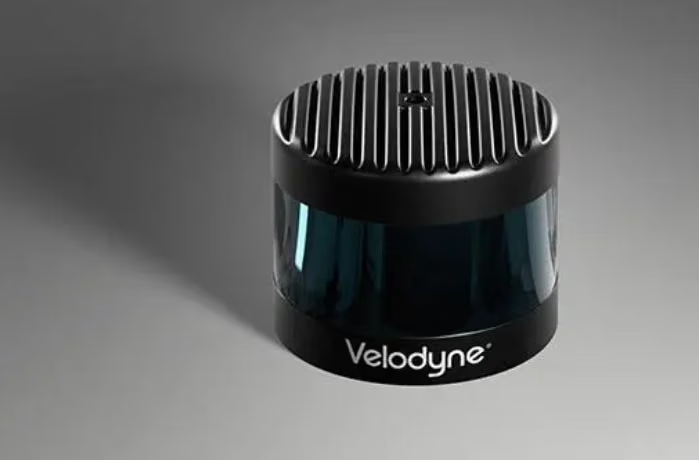
Note:
Computer vision is a science of image/graphics recognition technology
LiDAR is a radar system that emits laser beams to detect positions
Validating the Theory
It will be gradually validated over decades of development in the future automotive industry.
Summary
Some ideas may be immature and even laughable. I believe in actions over words, and I’ll use the development of the times to verify whether my current conclusions are correct.
Attached: current LiDAR usage among domestic Chinese EV startups
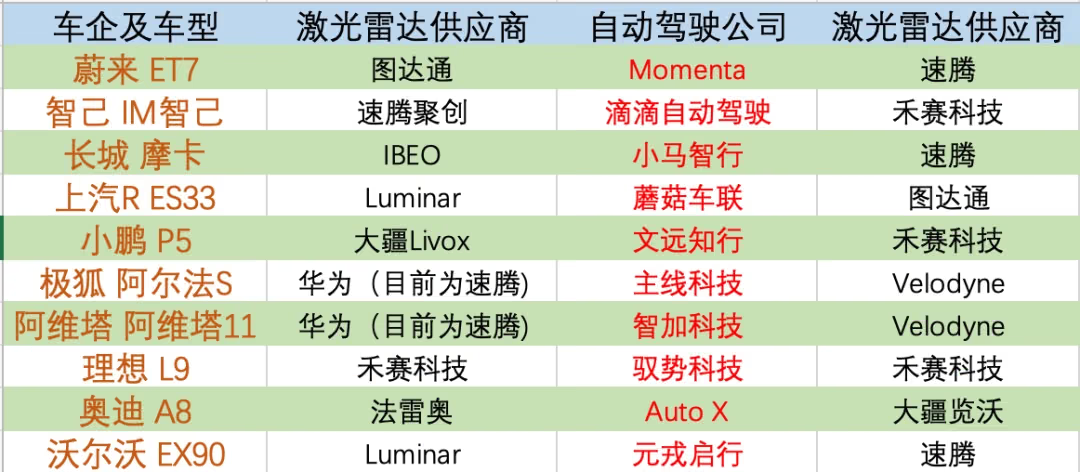
Reference: The Chinese market teaches LiDAR companies how to do business
The Sunyazhou Theory