Preface
This post carries strong personal opinions. If reading it makes you uncomfortable, please close it as soon as possible. This article is only for my personal study records; you are also welcome to repost or share it within the scope of the license. Please respect the copyright and keep the original link. Thank you for your understanding and cooperation. If you find this site helpful, you can subscribe via RSS. Thanks for your support!
Qing Ping Le · A 2024 Year-End Retrospective
The year’s end brings cold skies; looking back, the flowing years recede far away. Wind, frost, rain, and snow stretch the journey long, yet the dream has never changed.
Economic deflation sweeps in, laying bare how powerless people are. Layoffs and exploitation bring decay; the road ahead is dim and desolate.
In the winter of 2024, in memory of the merciless slaughter inflicted upon rank-and-file workers by enterprises that once had no trace of humanistic spirit or artistic temperament, amid the baptism of the sweeping waves of change in the internet era.
Apart from the constant risk of being laid off, life this year was almost entirely without incident. The white hair at my temples tells of quiet days without ambition. This was a year of patching and mending: nearly everyone kept their spending under remarkably tight control — if something could be fixed for a small amount of money, no one would spend money replacing it. Looking back over many years, this is an economic phenomenon never before seen: everyone is frantically saving money and refusing to consume, and when consumption is unavoidable, it’s merely the “lipstick economy” at work.
When people with no expectations for the future lose confidence that the economy will improve, life becomes devoid of pursuit and hope; one can only compromise with oneself as reality dictates and barely get by — and I am one of those people.
Against this complicated backdrop, let me look back at the people and events of this year.
2024 in Review
- Life
- Work
- Learning
- Hobbies
- Buying a Home
Life
The pandemic — after everyone got infected around the beginning of last year and population-wide immunity took hold — gradually exited the stage of history. Three years of hardship finally came to an end, as if to wake people up: from now on, be sure to save enough money to cope with long-lasting, sudden catastrophes.
The end of the pandemic also marked everyone’s return to normal life, and it led me to think about a few questions.
How Can a Family Be Revitalized?
Here are my thoughts:
The real reason a family stays poor is that the whole family lacks a broad-minded guide who goes into business or politics. The elders cannot plan for the ignorant younger generation, and they themselves pay no attention to vision and perspective, spending their entire lives working for others. The elders in the family are selfish, attach no importance to the next generation’s education, and when they grow old, they use filial piety to bind their children to obligation. Meanwhile, the children each go their own way, never united, quarreling endlessly over the slightest benefit — like a pile of loose sand, never learning to pool their strengths and resources — Huang Hongsheng
No outstanding family ever relies on the effort of a single generation; it relies on generations of mutual encouragement and joint effort. If the foundation laid by the grandparents is good, one need only follow it and maintain the status quo, and things will improve day by day. If one’s parents are ordinary people, then it falls to our generation to toil and till. Never pin your hopes on the next generation — only if we do well does the next generation have a chance to do better. If this generation does poorly, the next will most likely have it even harder. For noble families to rise within three generations, every transformation across the generations requires shedding a layer of skin and the hard pioneering of each generation.
So the following conclusions emerge:
The most pitiable children of the next generation are those with upbringing but no family foundation.
The most dangerous are those with a family foundation but no upbringing.
The most formidable are those with both a family foundation and an upbringing.
And of course the biggest failures of the next generation are those with neither.
It is precisely these different educational environments that make the gap between one’s own descendants and other people’s grow wider and wider, while the odds of the next generation turning things around keep shrinking.
When We Face a Survival Crisis, Who Can Catch Us When We Fall?
Looking back over these years, I seem to have always been holding a less-than-satisfying hand of cards, yet constantly fighting to play it well. From the moment of my birth, through my years of education, to buying a home and now raising a child, I have gradually come to a profound realization. Having parents is sometimes a blessing and sometimes a burden. The blessing is that if they have pensions, they can provide me with basic living security when I am unemployed or in financial difficulty. But when there is a large age gap between my parents and me, the problem appears. The stage at which they should be in their prime, helping me look after the child, is limited by age and health, leaving them struggling to keep up with childcare. The contrast with my peers’ parents, who are still strong and healthy, creates a psychological gap that is hard to bear.
This bitter life experience is not my fault, and yet it also seems to be. Not my fault, in that I could not choose the timing of my birth or my parents’ ages. My fault, in that I have not accumulated enough wealth to shake off these predicaments and achieve true independence, no longer depending on them. But life must go on, and I know deeply that the only optimal solution is to keep living hard and avoid repeating the same mistakes myself. So I regard this experience as 磨练灵魂的历程 (a journey of tempering the soul), and I have never stopped improving and growing. Keep honing.
What Are the Old Friends and Classmates Doing Now?
Whenever I step onto the subway, pull out my phone, open iBook and read Metal by Tutorials 4th 2023 — looking at professional graphics and imaging books that no one around has ever heard of, staring at cold technical points and shader code — I often wonder: are there really people around me like this, people who study strange, obscure functions every day? What are they all doing at this moment? At those times I feel utterly lonely. Perhaps, as Qin Xida says to Xiang Yunfeng in “Northern School Tomb-Raiding Notes”: “The strong are destined to be lonely…”
Work
By now, work is no longer a question of stability; it’s a question of when I’ll be laid off, collect my “big severance package,” and start figuring out what to do next. Every day I struggle and waver between continuing to dig deeper and preparing to job-hunt. I’ve lost confidence in work — after all, most people’s situations are hardly any better than mine. About my current company, all I can say is that I can still cope with the job, because I can’t tell which will come first: the company falling apart or me walking away.
The quality of coworkers really gets worse year after year. If it weren’t a non-core department, maybe the coworker quality would be low — it’s very hard to get back to the awesome colleagues I met at Baidu, the ones who taught me to write articles and blogs, practice calligraphy, and write code in their spare time. Those days aren’t coming back. It’s probably related to the current economic situation.
The Most Shocking Thing to Me
Tao, my former Baidu colleague, a Tsinghua University graduate, has to make an appearance in my year-end summary once again — the guy who scored 119 out of 120 on the math section of the gaokao, losing that one point (a dispensable one) for insufficiently neat handwriting. This year I heard he was laid off, which shocked me deeply. Beyond comforting him, it forced me to reconsider: does getting into a good university, having good credentials, still count for anything now? With undergraduates and graduate students unable to find jobs, I’ve begun to question whether studying is useful at all. I don’t know whether studying is useful, but building intangible assets — forming your own cognition, values, and methodology — requires it, and it will imperceptibly change our entire lives. Perhaps you don’t know what knowledge is for, but you certainly cannot afford the price of ignorance. The process of studying may well be a form of self-discipline and self-shaping, cultivating the quality of overcoming difficulties.
But there is one thing we seem to have overlooked: studying never taught me how to make money — after all, that isn’t written in any book. This is the main reason why, for all the things that happened above, I searched bitterly and found no answer. I believe this is a research topic that everyone has yet to crack.
Work right now is a sorry state: old age meets poor treatment.
Something Comforting
In Q1 this year I won an “Excellence Individual Chasing-the-Light Award” — just barely worth a mention in the year-end summary.


The funding given was about 2k; I treated everyone to a meal and got it reimbursed haphazardly. Not much use. Oh, and they gave a bouquet of flowers too. That’s it.
It’s been a long time since I won an award. The last time was probably the Outstanding Lecturer award back at Kuaishou! How embarrassing.
I won this award mainly for publishing an article, “Kuwo Music iOS Widget Adaptation and Development Practice,” on the QQ音乐技术团队 (QQ Music Tech Team) WeChat official account. I never expected that now, on all the major search engines, searching for widget development brings up my article. I’ll count that as a little encouragement!
If It Can Be Repaired, Don’t Replace It
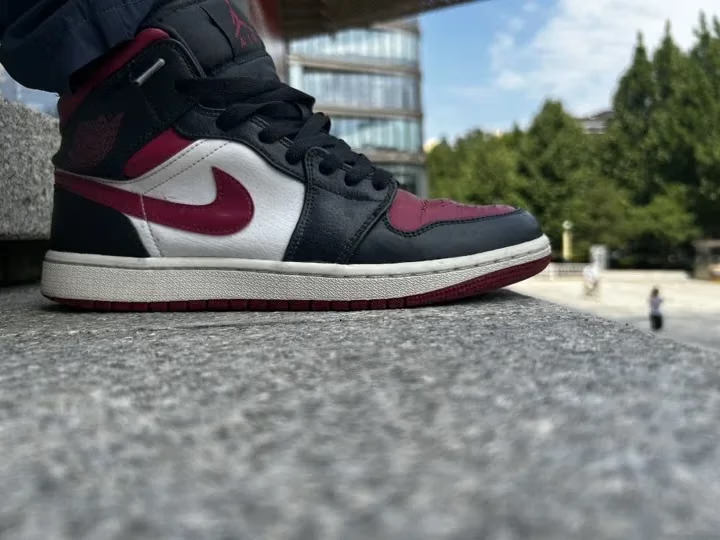
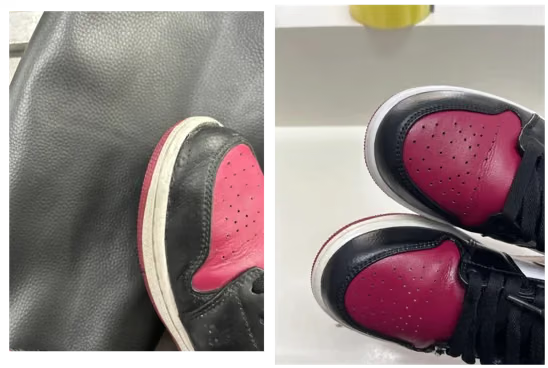
A few years ago I bought a pair of AJ1 sneakers on Dewu. Years of wear had caused the leather material on the toe to age. I asked all kinds of shoe repair shops and none of them could fix it. In desperation I found a craftsman specializing in AJ1 sneaker repair on Pinduoduo, and had them fixed for about 150 RMB — the result was great.
There’s also my AirPods Pro, issued during the Kuaishou 2019 Spring Festival Gala live event. After all these years, the internal speaker seemed to have come unglued and detached, and it kept rattling while I studied on the subway. So I found a professional repair craftsman on Pinduoduo who fixed it for 50 RMB. Apple’s official answer was either replace it outright, or it can’t be repaired.
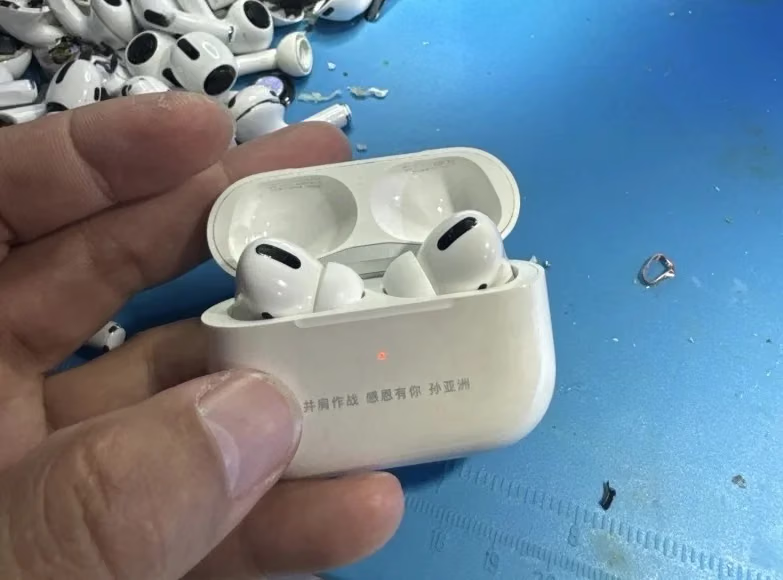
These two personal items perfectly embody my 2024 of patching and mending. There was no way around downgraded consumption: all my wealth was harvested by the government in one go for a house swap. The helplessness of the poor…
Learning
Continued Learning of C++

In fragments of time on the subway, I somehow unexpectedly managed to finish an entire book on C++. The moment I closed it, I felt as if I were standing before the gates of a magnificent palace of knowledge, with countless winding passages behind the door — each leading to deeper learning, each requiring more of my time and energy to explore. I feel as though I’m standing at the root node of a great tree, preparing to follow the branches of the tree, step by step, into every child node, even the leaf nodes at the very tips. Along the way, I have only my predecessors and successors as guides, and they will lead me onward through the world of programming.
Learning Metal Graphics
As soon as I finished the previous book, I moved straight on to the next one: Metal by Tutorials 4th 2023.12 — graphics on the Apple platform.

When I reached the halfway point of this Metal computer graphics book, I deeply realized that the computer knowledge I learned in university was merely superficial and slapdash — I had never gone deep into the field of graphics at all — which made me feel I had wasted precious time. Only now do I understand: this is the true essence of computer technology. If, in the early days of my career, a mentor had been there to point me in the right direction, perhaps I wouldn’t be living with the constant fear of being laid off the way I am now.
To get a clear picture of the APIs Metal provides, I tried writing several pages of notes, working out queue, command buffer, command encoder, pipeline buffer object…
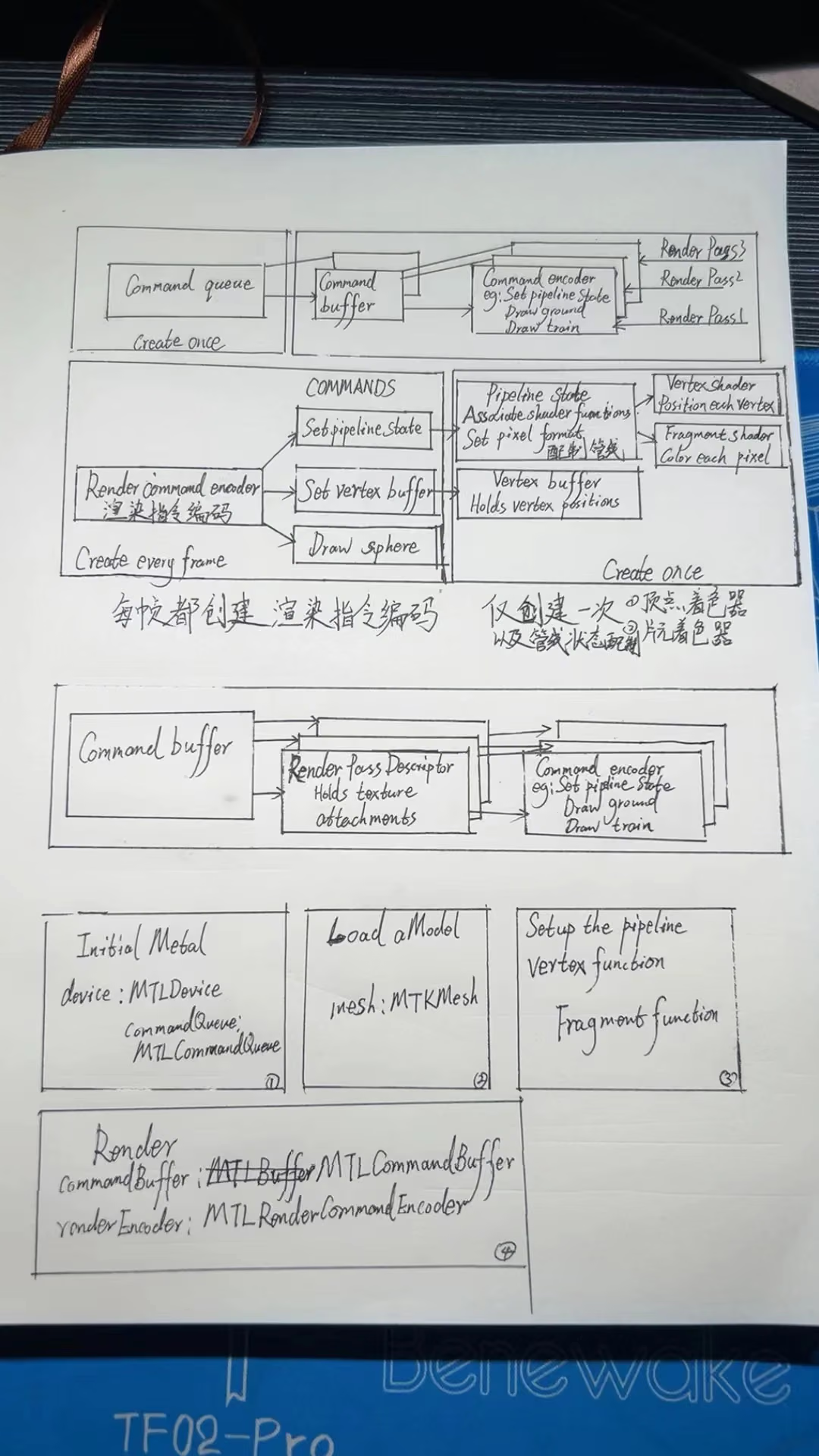
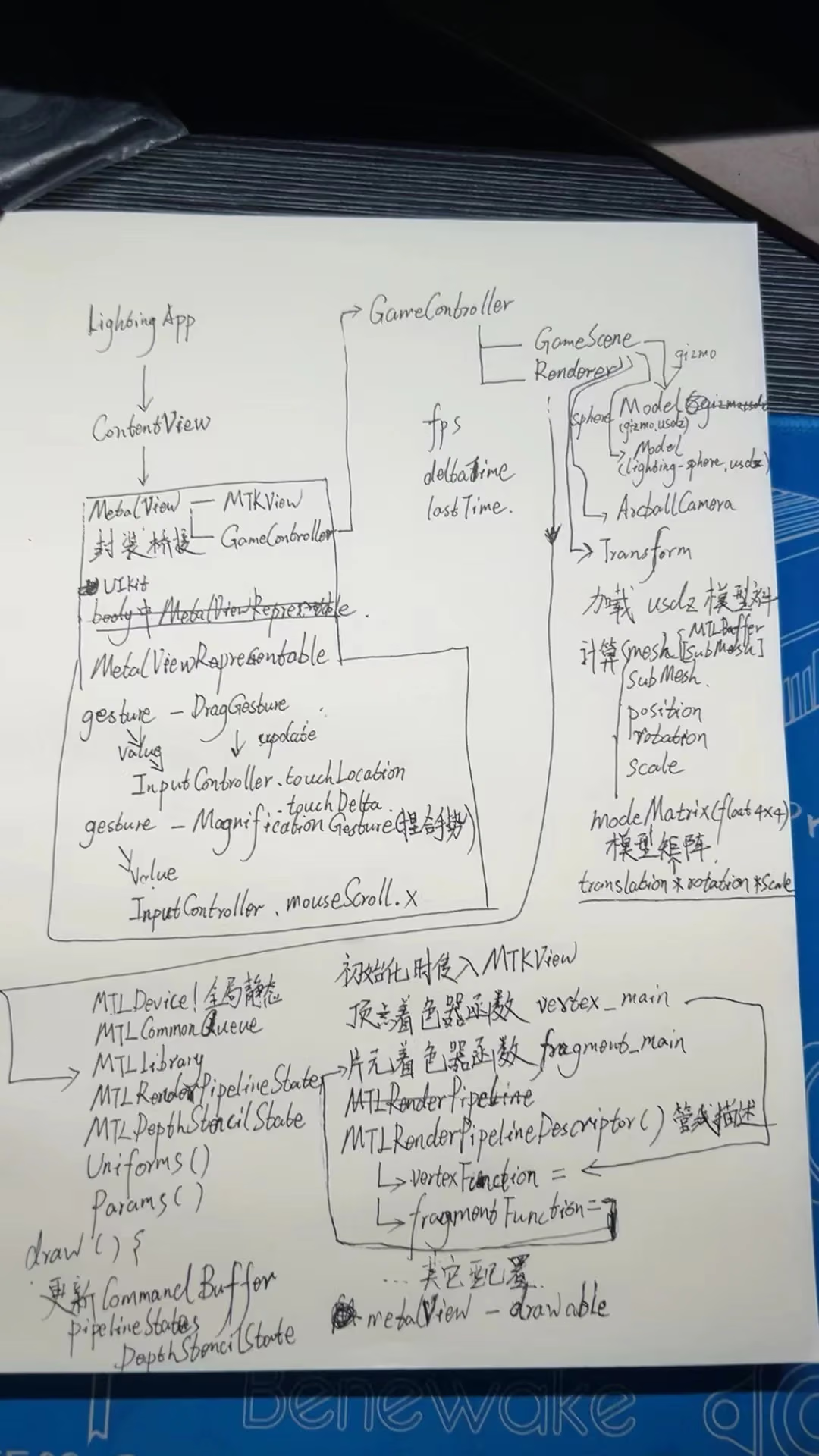
The drawings are far too scribbly — excuse the embarrassment.
As Newton said, the reason he could see further was that he stood on the shoulders of giants. I long to work hard and become one of those giants, so that more Newtons can see further.
This book is very challenging. It’s entirely in English, and it genuinely exercised my long-unused English reading comprehension skills. At appropriate moments I used the built-in iOS translation — but I always read it through once myself and then checked it once against the translation. When I diffed the translation against my own understanding, I could clearly feel my reading comprehension steadily improving. I just can’t hold the author to task for not writing standard British English; much of what he says I had never heard of, yet it manages to exist as a form of rarely used terminology.
While studying this book, I had no choice but to pick up some linear algebra along the way — Linear Algebra, the Full Course — Zero Fluff, Super-Concise! [Kong Xiangren] — because most of graphics falls within the domain of linear algebra. This counts as passive, follow-along learning.
At the very beginning, the second-order determinants covered are directly related to the matrix operations we use, because in the 3D world, performing position translation, rotation, and scaling (affine transformations) on an object all requires expressions similar to determinants. You could call this the foundation of graphics: if you don’t understand the internal functions when writing shaders later on, you’ll be completely lost — linear algebra is the theoretical support behind it all.
The knowledge point — or rather, my blind spot — that impressed me most in this book was my understanding of lighting. It turns out many predecessors did a great deal of research in this area, e.g., the Phong lighting model paper, the Fresnel lighting model, and more.
Based on the formulas and theory provided in these papers, you can handle techniques like light reflection and diffusion, as well as ambient occlusion (the code written in shaders is based on these kinds of formulas). For example, lighting models are divided into spotlights, point lights, and directional light (sunlight). On top of these lighting fundamentals were eventually derived [BPR](物理的渲染技术) — physically based rendering — and later the ray tracing technology (Ray Tracking) formed by multiple bounces.
Honestly, this one simple book has touched the deepest perceptions in my heart N times, and it keeps reawakening me to keep learning graphics.
The moments of progress are probably when an engineer is happiest (of course, so is financial freedom). Clearly, studying graphics is sometimes obscure, and for us here and now, making more money is basically out of the question. Studying some deep technologies may be a way of finding joy amid hardship.
When it comes to learning, I wonder if you’re like me: at the start of the year you plan to study a pile of things, but they constantly get preemptively scheduled away by other higher-priority things, so in the end you learn nothing and have nothing to say at year’s end. So at the beginning of 2024 I changed my approach: no matter what, first focus on studying one technology as best I can, and only after finishing it move on to the next. If I genuinely feel bored and listless along the way, I temporarily find something interesting to do, and once the relief sets in, gradually and steadily return to the previous direction of study. After a year of practice, this approach has proven very effective. I call this method 线性偶发被干扰学习法 (linear, occasionally-interrupted learning).
Hobbies
Around 2020, I felt as though I had a kind of depression: I had no ambition for my work in Beijing. At the time I wasn’t aware of it myself — perhaps with better awareness it would have been lighter — but even now, looking back, I still feel I never found a way to resolve that depression, until I later encountered billiards and kept digging deeper and deeper: watching matches and tournaments to learn the rules, and learning from tutorials on Bilibili while practicing.
I still love it and have never given it up. What I do now can no longer be called just playing: I’m gradually learning how billiard halls are run — operating costs, equipment brands, and repair-related matters. The prerequisite for developing this into a second curve is first to have a comprehensive understanding of it, so you know whether this business can be done and how much investment it takes. I’m a billiards enthusiast, and I always try to understand the development of the billiards industry with an engineer’s mindset.
I’m optimistic about this business for two reasons:
- Under the current economic deflation, ordinary people rarely spend money
- The effect of the lipstick economy
Because the economy is poor right now, income becomes critical when work is unstable. People don’t dare to spend, and can only satisfy their need to consume with small amounts of money. This kind of billiards economy fits perfectly with the way people consume under such an economic backdrop: spending a little money brings a lot of happiness.
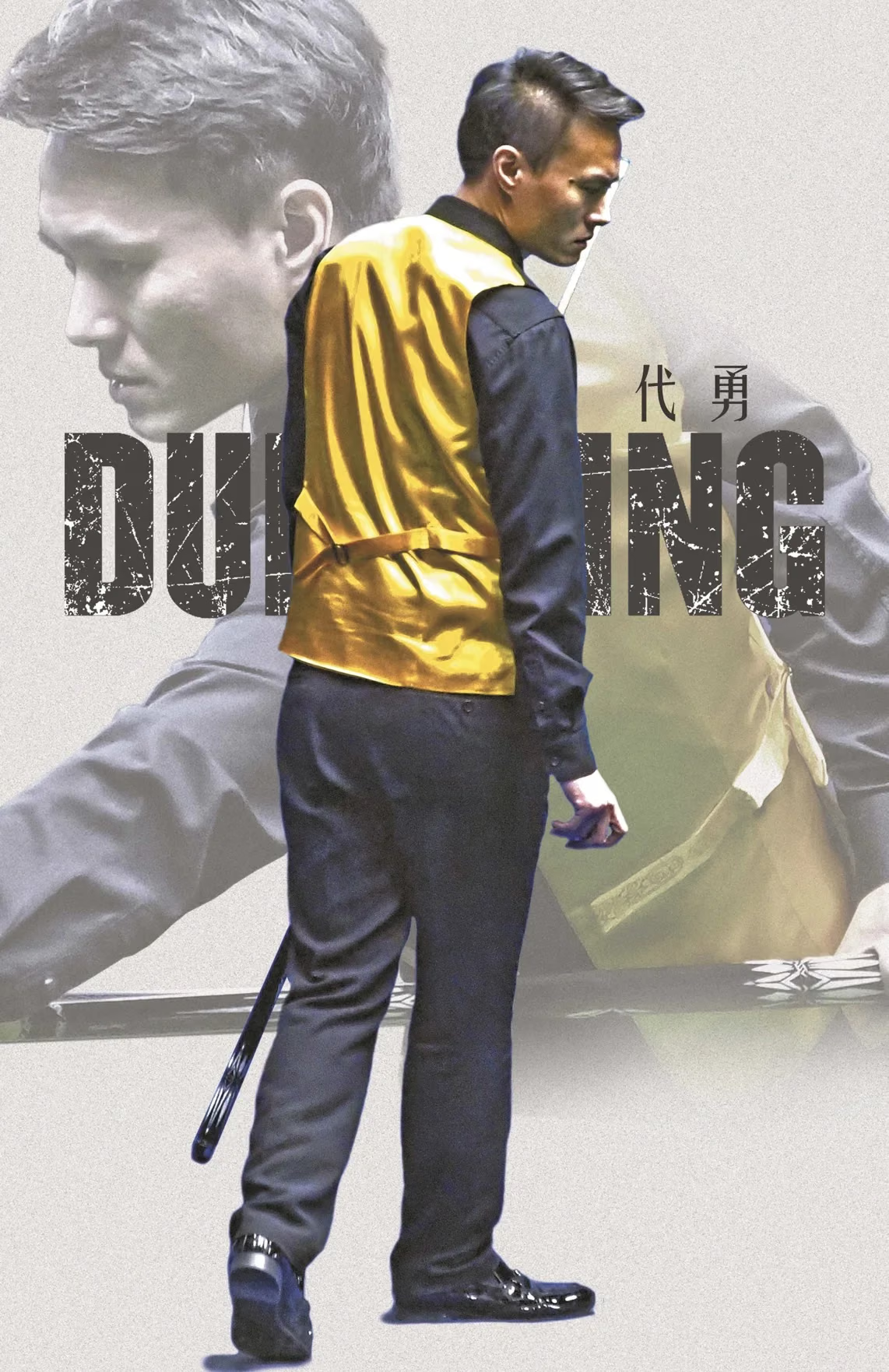
Billiards is deeply healing for me. When my work stress is high, this sport is so elegant. After more than two years of practice, I’ve gained a basic understanding of billiards. When a former colleague came back to China from Singapore, I used billiards to share with him how a person can conquer the loneliness of leaving their hometown with no one to turn to.
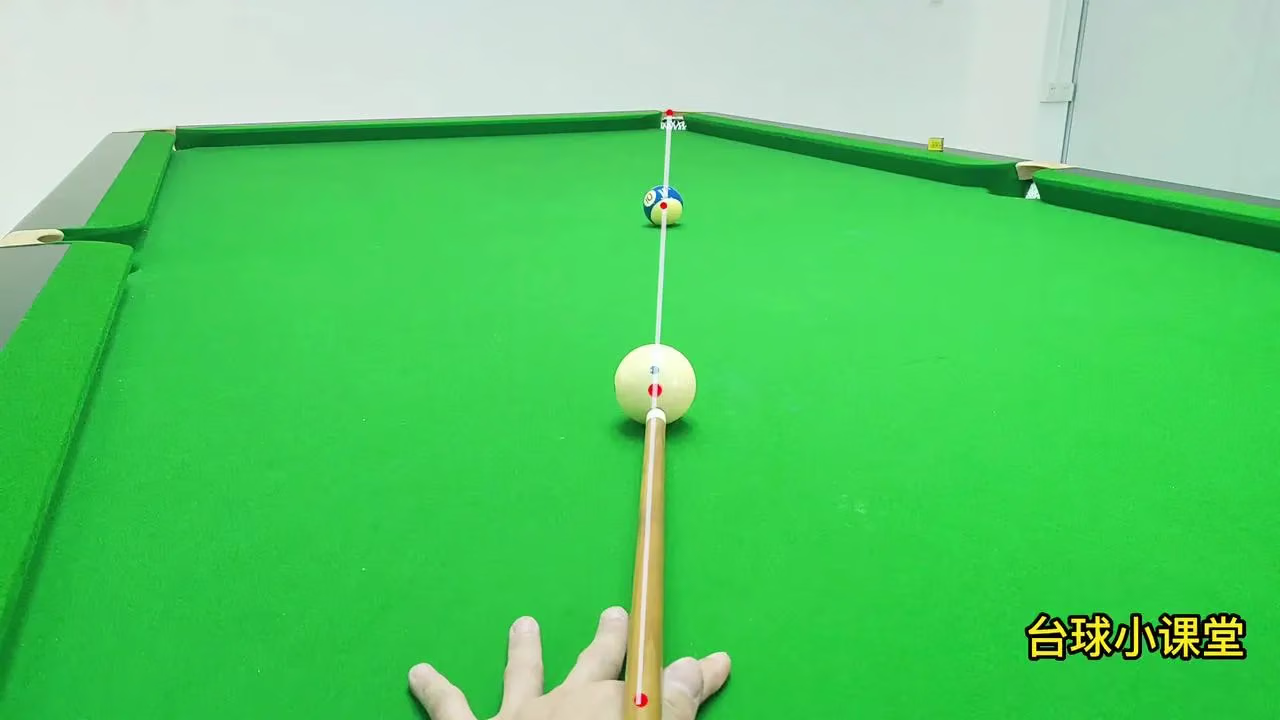
Life is like that white cue ball: in the five-point challenge, three points in a line, aiming at the pocket. When the quality of our stroke is poor, or the contact point on the cue ball is inaccurate, these mistakes all feed back into the trajectory of the white ball. As we keep searching for the correct contact point and correcting our errors, we can adjust the direction of our life and set it back on the right track.
Reflections on My Billiards Hobby
Sometimes I fall deep into thought: do people really need to have hobbies? Like dreams, hobbies often need money to support them. When one’s personal means don’t match one’s dreams, does a hobby become a luxury?
First, hobbies undoubtedly satisfy my emotional needs, bringing joy and fulfillment to my heart. They can ignite our passion and give us comfort amid busyness and pressure.
Second, hobbies help shape an independent character. By pursuing our own interests, we discover ourselves and cultivate unique personality and creativity.
Furthermore, hobbies can absolutely be pursued within the limits of what one’s finances allow. A hobby doesn’t have to be expensive; what matters is finding activities that bring joy and a sense of achievement, without excessively pursuing material investment.
Finally, without hobbies, I can’t help but ask: do we live to endure the bitterness of life, or to pursue the goals that keep us going? Hobbies don’t just enrich our lives; they are also an important path toward happiness and fulfillment.
Joy’s Push to Get Chinese Eight-Ball Into the Olympics as a Sport
Once we wore the label of a “hooligan’s game,” sweating it out on street corners and in alleyways, while we could only look up at high-born snooker and nine-ball, sighing in vain. We were like grass in the cracks of stone, weighed down by the crushing pressure of barely being able to break through — humble, small, cold-shouldered and despised, even nearly strangled without mercy. Ding Junhui has his own villa, and Pan Xiaoting’s sports car is quite luxurious too. But we had nothing — only bitter practice after work, drifting from place to place. We used ourselves to prove this sport’s existence, tasting all the sour and sweet of the human world. Because of love, we could not let go; because of dreams, our hearts grew immensely strong. We gritted our teeth and persevered, practicing alone — moving how many people to tears and fire. A certain “uncle” heard our anguished cries: Joy took up the great banner and fought side by side with us. Joy filled us with endless hope, and we fought hard for Joy, never giving up, never falling. A band of rebels who refused to bow to fate finally breathed a sigh of pride. Every stroke swung under crushing pressure was a silent strike against fate. And this old man pushed this sport onto the world’s Olympic stage, a feat that became a much-told tale. Only then did I learn that billiards could be this great. The Joy Chinese Eight-Ball Masters is already 18 years old; it will surely venture forth into the world’s sporting events, wiping away that “hooligan’s game” label for us humble billiards lovers while leaving the glory of this sport under the spotlight of the world billiard stage.
The Future of Billiards
This sport has shown me a fairness of competition I had never felt before — pure skill does the talking. It contains a great deal of technique and knowledge. To ordinary people it probably looks like nothing more than a few wooden sticks and a tabletop with green cloth, but in fact there are many opportunities here waiting to be unearthed: for example, the best-quality cushion rubber comes from China’s Zhenhong Rubber (the rubber strips along the table rails); the best cloth makers are China’s Liberwintex and UK’s Strachan 6811. Cue brands of every kind are endorsed by professional players, though plenty are good — Peri, Lis Billiard Club, Lankou, and all sorts of brands, as plentiful as cars. There are also companies making cue tips and chalk, such as Xiaomai tips and HR chalk. Without going deep into this industry, you’d never understand its supply chain — even the slate suppliers, and the Aramith TV balls imported from Belgium. In recent years, Huyi Lighting (a company specializing in shadowless lamps above billiard tables) has become quite popular, and there’s also Shenglizhe, which specializes in sofas made for billiards.
This is an insider’s business. We always say that under the current employment pressure it’s hard to find our own second curve. Here’s what I’d say: whatever the curve, it takes time and energy to understand and study in depth — every curve is reserved for those who are prepared.
Buying a Home
At the beginning of the year I bought a shared-ownership home in Daxing District, Beijing. First of all, with real estate policy gradually loosening and all kinds of policy stimulus, I had to consider living in Beijing for the long term.
Let me start by going over which policies I happened to catch:
- “Restricting home purchases but not commercial loans” (the previous policy: if you had a single property anywhere in the country with an outstanding loan, it basically counted as a commercial loan, and in Beijing you would need an 80% down payment to buy; after this policy was loosened, the restriction applied only to commercial loans within Beijing) — in other words, having used a commercial loan elsewhere no longer directly restricted buying in Beijing.
- Supervised escrow accounts (the down payment goes directly into an account supervised by the developer and the government, to prevent developers from collapsing and leaving unfinished buildings). This is one of the policies the government had no choice but to introduce because of problems that kept appearing in recent years. The tight-money rule — that funds in the supervised account are only released to the developer once the building is topped out — genuinely broke many developers of unfinished-building projects.
- Interest rate cuts: the provident fund rate for terms over 5 years is 2.85% — already far lower than the previous commercial rate of 4.9%.
- Higher provident fund quotas for green buildings (this relates to how the developer builds — constructing buildings that meet the national Class-II standard). I didn’t end up using this one.
- Outside Beijing’s Fifth Ring Road, only 3 years of continuous social insurance payments required. I didn’t use this either — I used a Work Residence Permit, which has no such restriction.
…
Later came many more toothpaste-squeezing policies that I won’t list one by one. Let me just mention one thing you can’t see — the flip side:
If you buy a home in Beijing with a provident fund loan, you must ensure you don’t lose your job within half a year, because Beijing’s provident fund loan has to be completed within about a month from building top-out to handover. From the grouped lottery and unit selection at the start of the year to finally completing the provident fund disbursement took me a full half year: the first several months were waiting for the building to top out, and the final month was processing the provident fund. I want to say: if you lose your job along the way, your provident fund status turns to “sealed,” and congratulations — you probably won’t be able to get any mortgage at all. It’s almost like being abandoned by society: commercial lenders won’t dare lend to you without stable employment, and a sealed provident fund account can only return to “contributing” status when your next company starts paying in for you. How can you guarantee you’ll find, in a short time, a company that pays the full five insurances and one fund for you? The uncertainty is just too great! And paying through an agency doesn’t seem reliable either! In short, I think that in the current terrible economic climate, without courage and real financial strength, don’t attempt this move — it’s absolutely awful. Luckily my current company didn’t hand me the “gift package” and walk me out; otherwise I’d be using myself as a cautionary joke for you all. Reading this, you may think I’m joking. I want to say: this is completely objective reality, without a hint of humor.
This system, I think, is something the country should hear feedback on — it is extremely unfriendly to the unemployed. Who can guarantee their job is stable? Nowadays nobody dares to guarantee stability. Who would buy a home in that state — wouldn’t that be crazy? With unstable work income, how many people are willing to take the risk for the thrill of it?

Going through this home purchase left me feeling how close a call it was. For penniless poor people, buying a home in Beijing is truly an enormous challenge. You really don’t know whether unemployment or tomorrow comes first! Without parents to catch you in life, and with the state taking away young people’s entire income in one go — even emptying parents’ wallets — how can there be any consumption left? How could the economy possibly improve? The economy can only stagnate.
Summary
In 2024 I genuinely felt how poor I am: anything that can be repaired will never be replaced with something new. Even amid all the changes and turbulence in the world this year, I — living in the cracks — have kept surviving against the odds, swaying left and right all the while.
In 2024 I published a lot of shallow articles; some aren’t even worth mentioning — they’re purely insurance against forgetting and not being able to find things again. Work has been busy, and the little one at home takes up much of my spare time. I now think the best place to study is Subway Line 8: on my two-hour daily commute, at least 50% of the time goes not to junk videos but to studying technology. It may look utterly joyless to others, but for me it’s finding joy in hardship — call it digging the moat of my technical fortress a little deeper while the industry still moves forward. Although I don’t currently have any optimal solution to this problem, I’m still trying new approaches in search of one.
In 2024, workplace competition reached new heights and became the trendy thing to do against the current backdrop of the times. The next few years will probably be even worse. I’m practically a pessimistic member of society holding out no good hopes.
That’s about it! For 2025, there must be something to look forward to. My hope is simply to finish learning Metal and put it to use. Because poverty can’t be changed, the current situation can’t be changed, financial freedom is a pipe dream, and earning more money is basically nonsense. The only thing under my control is to keep studying tirelessly and raising my awareness — that is the optimal solution to the problems above.
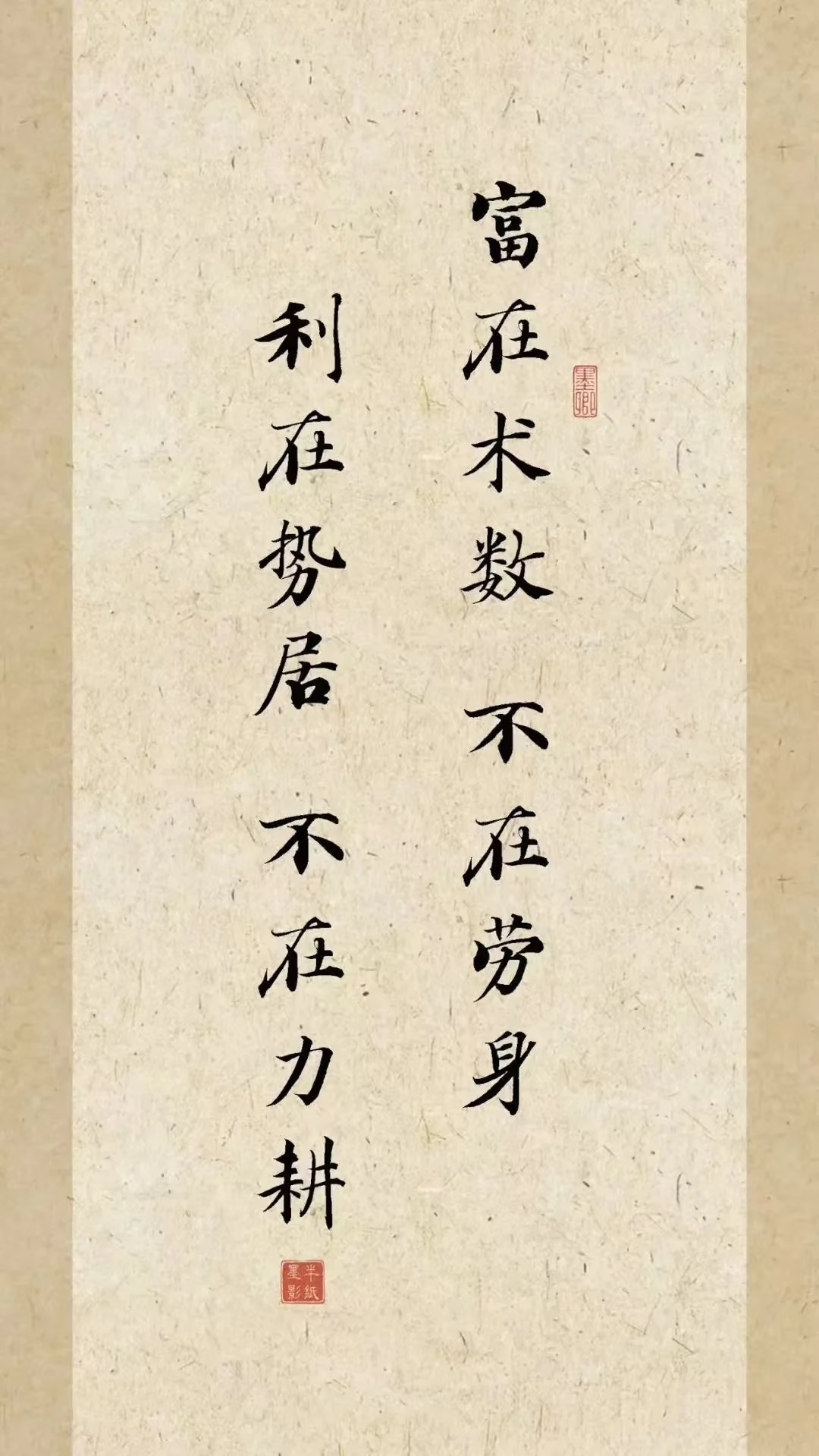
Finally, let me put down the two most useful lines I read in the “Discourses on Salt and Iron”!
Goodbye, 2024.